Help Your Child Know Right From Wrong — Even When No One's Watching
A workbook that helps kids 8–12 build honesty, empathy, and courage into who they are — through real dilemmas, not lectures.
- ✓Builds honesty, empathy & a strong sense of identity
- ✓Fits in even the busiest schedules — 15 mins a day
- ✓No religious teaching — just universal values
Myth: kids who lie or cheat are just "bad kids"
Most kids aren't born knowing right from wrong. Someone has to teach them — or nobody does.
A child who lies about homework or copies an answer isn't a bad kid — they just haven't fully learned right from wrong yet. That's normal at this age. And like any skill, it needs practice.
Kids first learn to be good because they're scared of getting caught. Then they do it to fit in with friends. Only later do they learn to choose right over wrong just because it's right — even when no one's watching.
Getting to that last stage takes practice. Kids need to work through tricky situations where the right answer isn't obvious — not just be told "don't lie" or "be kind."
A child who's practiced a hard choice before is much more likely to make the right one later — even when it's easier not to, and even when no one would ever find out.
Most schools don't teach this. Maybe one class a week, if that — a few rules on a poster, not real practice making a hard choice.
That's where the trouble starts. A child who's never practiced choosing right over easy copies an answer when no one's looking, goes along with a group that's leaving someone out, or can't say why something felt wrong — simply because no one ever showed them how to think it through.
A real family
See how the workbook is changing how kids choose
"She told her teacher she'd copied the answer before anyone even asked. I didn't teach her that."
"She used to go quiet when a friend was left out — now she actually speaks up."
"The dilemma cards started conversations we'd never have had otherwise."
"She's more sure of who she is now, not just what she's told to do."
What's inside
The complete workbook to raise a child with a strong compass
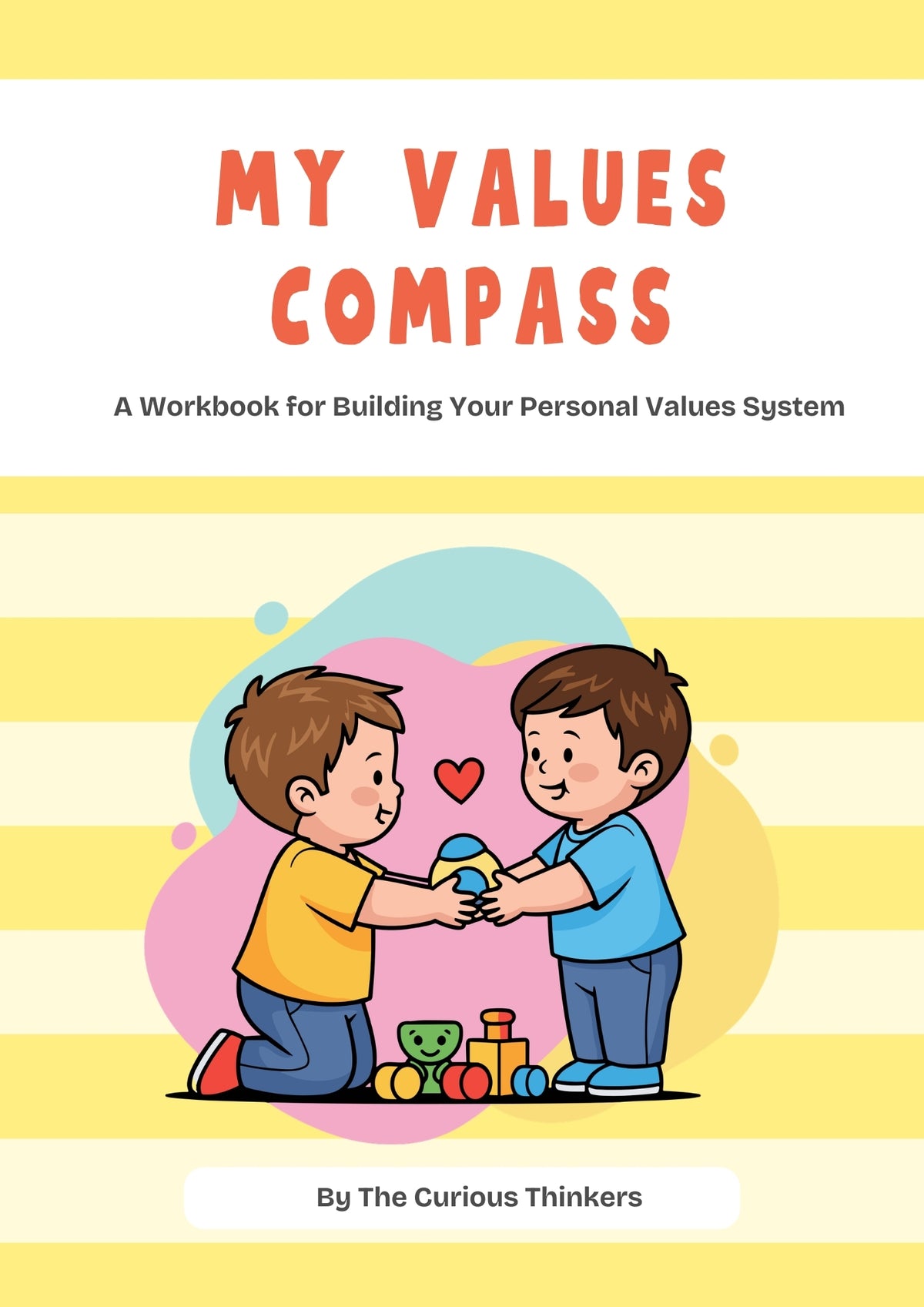
A guided 4-part journey — meet your values, navigate the grey zone, practice integrity, find your courage — that turns "because I said so" into a value your child actually owns.
Meet Your Values
Kids discover what a value actually is — honesty, kindness, fairness, courage — and start naming their own.
The Grey Zone
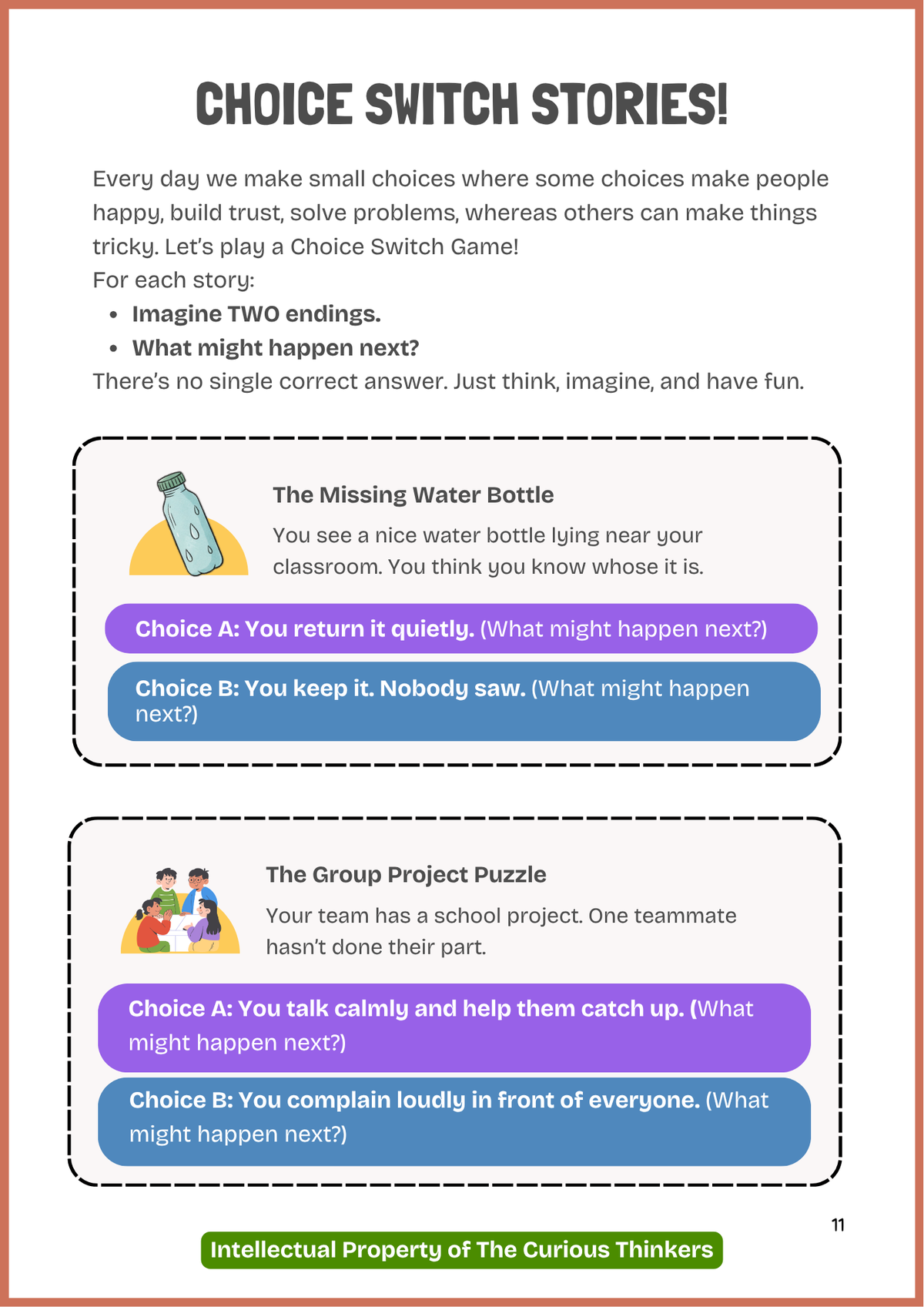
Real-life dilemmas where the "right" choice isn't obvious — kids practice weighing what's fair, kind, and honest.
Doing Right When No One's Watching
Kids practice honesty and integrity through scenarios about cheating, borrowing, and owning up to mistakes.
Standing Up, Speaking Out
The "What Would You Do?" game and family dilemma cards build the courage to defend someone, even when it's hard.
The difference
Why parents choose this over sermons, rules, or one-off talks
No preaching, no religious framing, no "because I said so" — just a simple, proven method your child can practice anytime.
Grounded in child-development research
Every page follows how kids actually build moral reasoning, so parents aren't guessing at the right lesson.
Real dilemmas, not rules on a poster
No "be honest" lectures. Everything is built around situations your child actually runs into — at school, online, with friends.
Secular and screen-free
Universal values — honesty, fairness, kindness, courage — with no religious framing, worked through on paper.
Works with or without you
Built so kids can use it independently once they know the format — with family dilemma cards to work through together.
What changes at home
Stronger values. Steadier choices. A child who knows who they are.
What's included
Everything your child needs to build real character
One workbook, four tools, zero guesswork — here's exactly what's in the box.
Our promise
We stand behind every workbook we send out
You get 15 days of post-purchase support — reach out to us for anything at all, and we'll help you through it. And if you work through the entire book and see no change in how your child handles a hard choice, write to us and we'll make it right. We care about the outcome for your family more than we care about the sale.
The honest comparison
Why parents switch to this after trying everything else
9,000+ parents
One common reaction: "She surprised me with her own honesty."
Here's what happens when kids finally get to practice hard choices before it matters.
"My son told me he'd taken his sister's chocolate before I even noticed it was missing. That workbook is doing something right."
"The dilemma cards started conversations at dinner I never expected to have with an 11-year-old. She has real opinions now, not just rules she follows."
"I was worried this would feel preachy. It's the opposite — it's playful, and he actually asks to do the next page."
"She stood up for a classmate who was being teased — and told me about it like it was no big deal. It was a big deal to me."
Questions
The most common things parents ask before ordering
Is this based on any particular religion?
No. The workbook is entirely secular — it focuses on universal values like honesty, fairness, kindness, and courage that every family can agree on, regardless of background or belief.
Will this feel like a lecture on morals? My child hates being preached to.
This is designed to be the opposite of a lecture. There are no "always be honest" posters — just real dilemmas, games, and family cards where your child works out the answer themselves.
My child is 6 — is that too young? Or 13 — is that too old?
The sweet spot is 8–12, but we've had parents use it successfully with mature 6-year-olds (with some help) and with 13-year-olds who liked the harder dilemmas. If your child can follow a short story and hold a pencil, they're ready.
What if my child already lied or cheated recently — is it too late?
It's never too late — this isn't about punishing a past mistake, it's about building the skill for next time. Most kids who lie or cheat simply haven't practiced choosing differently yet.
What if we start it and my child loses interest halfway through?
The workbook is designed in short, self-contained activities — not one long assignment. If they lose interest, just pause and come back. And if it truly doesn't work for your family, our 30-day promise has you covered.
Does this replace the values we teach at home?
Not at all — it's built to support what you already teach at home, giving your child structured practice and giving your family a shared vocabulary to talk about hard choices.
Before you ask
Is this just worksheets, or is there an actual method behind it?
It follows a structured, developmentally grounded framework — not random activities — moving from naming values, to navigating grey areas, to practicing integrity and courage, so the skill builds progressively.
How many pages and chapters are there?
There are roughly 32 pages and 4 chapters in the workbook.
Do I need to sit with my child while they do this?
Not necessarily. It's designed so kids can use it independently once they understand the format — though many parents do the family dilemma cards together to make it a shared routine.